
What Just Happened: Recap of the NH House March 11-12, 2026 Session—Special Abuse of Power Edition
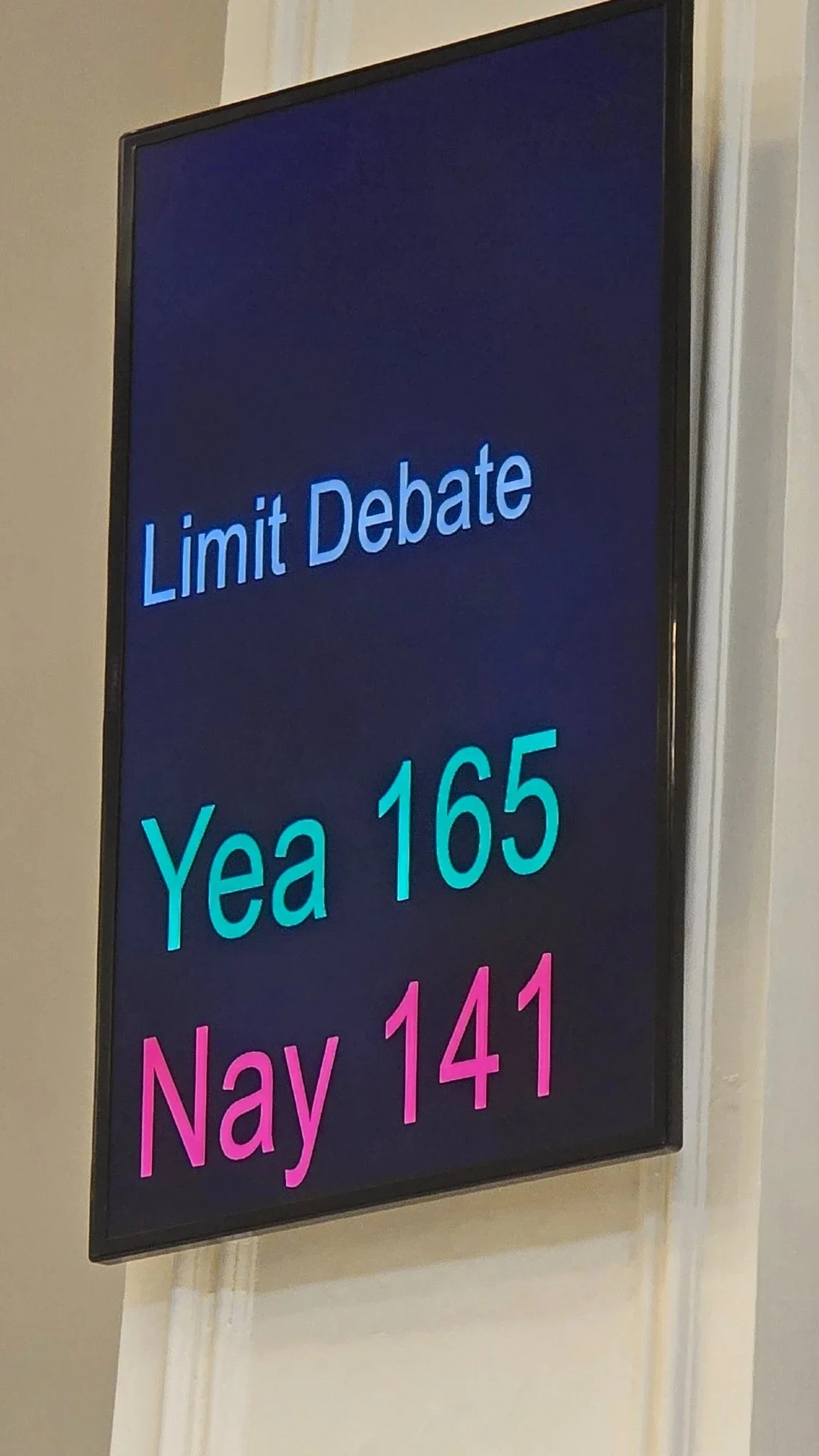
Concord’s “free speech” crowd in action…
From using parliamentary maneuvers to strangle debate, to killing dozens of bills without even conducting votes, last week NH House Republicans showed the people of New Hampshire what intentional mismanagement combined with extremism and cruelty looks like. Here’s a quick recap of the good, the bad, and the ugly.
Setting the Scene
Usually the days leading up to a House session are fairly quiet as reps plan strategies and floor speeches and 98% of the New Hampshire media dozes in its usual somnambulant stupor. But as this week started, Rep. Wendy Thomas, one of the Merrimack state reps whose outspoken efforts blocked an immigrant detention center from being built in her town, was removed from her legislative committee with no explanation—a disciplinary action usually reserved for reps who have actually done something wrong. On the heels of this, a Republican legislator with a history of making race-baiting statements who actually did do something wrong skated off with no punishment after making an anti-Semitic email response to a Jewish Democratic legislator who had the temerity to invite legislators from both parties to a post-session, bipartisan karaoke night at a Concord watering hole. But as proof that there may be something to karma after all, we received some unexpected and wonderful news. On Tuesday, Wolfeboro Democrat Bobbi Boudman electrified not only Dems in New Hampshire but Dems across the country by defeating MAGA/Freestater Dick Fincher in a special election for a vacant state rep seat in a historically deep-red district.
With these events rattling around in our heads on Wednesday morning as we drove to Concord, legislators like me knew that with hundreds of bills scheduled for debate over the next two days, we were facing late nights, short tempers, and tons of exasperating moments. To set the scene even further, the number of bills we thought we’d be debating and voting on were equivalent to the number of bills we’d normally see over 4-6 session days rather than just two. On top of this, Republicans—who control which bills are scheduled for votes—decided to frontload the calendar by taking up ALL the bills they wanted to PASS on Wednesday (which were mostly Republican) and ALL the bills they wanted to KILL on Thursday (which were mostly Democratic). Looming in the background of all this was a midnight Thursday deadline. So any bills not taken up before then, would simply die without a debate and without a vote.
Expecting the Wednesday session day might not end until midnight, reps living longer distances from Concord were advised to book hotel rooms (at their expense) to ensure they would be reasonably fresh for the start of session on Thursday.
No need.
The first motion Wednesday morning from MAGA/Freestater-in-Chief Majority Leader Jason Osborne (more about him here) was to “limit debate.” The motion passed 165-141. This served to eliminate floor speeches and restricted debate to short parliamentary inquiries or “PI’s”. PI’s are usually delivered by both sides AFTER floor speeches are made and usually consist 2-4 abbreviated points either in support or opposition to a bill. Imagine having the make your entire case using only the number of words you can cram onto a Post-it note and you get the idea. By severely limiting the ability of legislators to advocate for or against their position—not to mention the ability of other legislators to get the information they needed to inform their votes—debate was mostly strangled.
As you might expect, Democrats were prepared for this, but weren’t pleased to see it become reality. Had Republican leaders simply scheduled two or three additional session days in February or March, the overloaded calendar could have been reduced or avoided completely. But what they decided to do instead was to hold bills that had already received recommendation votes in committee (some as early as January)—and to keep holding them—until a clog of bills was created precisely at the time of a legislative deadline.
Full disclosure: A week earlier, the same Republican leaders who control the calendar and intentionally created this mess, offered to make a rules change to extend the deadline by a week. Democrats declined to agree. Why? Because the deadline had been set months before and Republicans had purposefully created the problem through their own manipulation, stalling, and intentional mismanagement of the process.
Those of you with longer memories may recall that in in 2020, when Republicans were in the minority, they also declined to agree to move a legislative deadline as the COVID pandemic was closing in—forcing legislators in both parties to stay in the State House to vote on bills until 4:30 am. Amazingly, all of those bills were debated and received votes—something that became a source of pride for the legislators who were partnof that very long day—including me.
But sadly, actually doing the work was never part of the Freestate/Republican plan. After limiting debate on Wednesday and taking up leftover bills from Wednesday on Thursday, Freestate/Republican leadership announced its intention to adjourn to Dem leadership. This would have effectively killed ALL bills remaining on Part II of the calendar on Thursday. While Dem leadership was able to negotiate votes on a handful of the Thursday’s bills, the session ended with most simply dying with no debate and no vote.
To be clear, nearly all of the bills originally scheduled for Thursday had “Inexpedient to Legislate” recommendations from Republican-controlled policy committees. Given the 30-40 vote Freestate/Republican majority in the chamber at any given time, these bills likely would have been killed in full House votes anyway. But after all the work from legislators that went into researching and writing them as well as all the time spent by committee members and advocates in public hearings, simply allowing them to die with no votes and no debates wasn’t just business as usual. It was an abuse of power and a violation of a long held tradition that every bill receives a hearing and a vote.
So what happened to the bills that actually got votes? Here are some of the highlights and lowlights.
The Good
HB 1704, a bill promoted by out-of-state groups that would have effectively killed public employee unions, was indefinitely Postponed by a 177-159 vote. (This parliamentary maneuver is the legislative equivalent of killing it with a flamethrower, shredding the ashes, and launching it into space in the general direction of the Crab Nebula. It ensures the bill—or anything substantially similar—can’t be brought back for a vote for the rest of the legislative session).
HB 1313, which would have repealed anti-harassment, patient-safety buffer zones from reproductive health care facilities, was killed 171-163.
HB 661, which finally resolves a blatantly unfair situation that now allows the state to pocket social security and other benefits that children in foster care are supposed to receive instead of holding those funds to return to the children once they are out of the system, passed 309-19.
HB 1721, an insanely damaging bill that would have eliminated solar and wind energy from the state’s Renewable Portfolio Standard, increased energy costs, hurt clean energy investments, and killed off the Berlin biomass plant once and for all, was tabled 198-152.
HB 1464, which would have changed state anti-discrimination laws to make political affiliations and beliefs a protected class similar to age, race, gender, religion, and other protected classes, was killed 242-97. While many Dems were sympathetic to the intended aim of the bill in protecting politically-outspoken people from harassment that can result in job loss and reputational harm, there was concern that giving political beliefs, which are transitory and can shift at any time based on events or new information, the same weight in our law as factors that are inherent and core traits, would be a huge mistake at a time when the legislature is also considering removing non-discrimination protections from transgender people.
HB 2026, an update of the state’s 10 year transportation plan, passed 338-13. While passage is good because it will fund many important projects, a decline in federal funding and gasoline tax revenues means several critical projects didn’t make the cut. More.
HB 1561, an openly racist bill reminiscent of a 19th century embarrassment known as the Chinese Exclusion Act that would have banned Chinese nationals from attending New Hampshire public colleges and institutes of higher learning, was killed 186-150.
HB 1675, a grievance bill that would have established a commission to investigate the New Hampshire Coalition Against Domestic and Sexual Violence, was tabled 168-155. (On Thursday, a move to take it off the table failed by an even larger 130-190 margin)
HB 1418, a local control-strangulation bill framed as “property tax relief” by MAGA/Freestate Republicans that would have required new spending by towns to receive approval from 15% of all registered voters in order to pass, was tabled by voice vote. 15% by itself is a higher-than-average attendance at ANY town meeting—and requiring near-unanimous approval would have effectively made any new spending impossible.
CACR 18, a constitutional amendment that would have imposed a spending cap for municipalities based on inflation and population up to 2.5%, failed to reach the required 3/5 majority.
HB 1616, an other anti-vax bill that would have banned state agencies, counties, and communities from advertising or spending money on “advertising vaccines”, was tabled 293-18.
HB 1275, a bill authorizing the Department of Environmental Services to set maximum allowable concentration levels for PFAS in sludge and biosolids used for farming—and to prohibit spreading of materials with higher concentration levels—passed by voice vote.
CACR 15, a constitutional amendment that would have created a constitutional right to hunt, fish, and “harvest game” (aka trapping), failed to reach the required 3/5 majority vote. There were concerns that the amendment could be used to challenge hunting fees, statutes, and wildlife rules. But another major concern for many Dems was that felons or people subject to domestic violence protection orders could argue a gun is a protected hunting tool and have their firearms restored.
CACR 21, a constitutional amendment that would have banned something already illegal under New Hampshire law—non-US citizens from voting in elections—failed to reach the required 3/5 majority vote.
CACR 24, a constitutional amendment that would have elevated parental rights to a constitutional level resulting in expensive litigation over public school standards and cirricula, failed to reach the required 3/5 majority vote.
The Bad
HB 1240, a bill that elevates the penalty in a criminal threatening charge from a misdemeanor to a class B felony if a “replica weapon” (such as a realistic-looking squirt gun) is used, passed 170-162. Newsflash: Using a real weapon in a criminal threatening incident is already a class B felony. This bill essentially makes it possible for a person who threatens another person with a “weapon” that presents no threat of actual harm to be sentenced to 1 to 3-1/2 years in state prison. The increase in penalties for this imaginary threat to public safety comes a week after House Republicans passed another bill repealing the state’s current prohibition against selling or possessing blackjacks, brass knuckles, and other streetfighting weapons.
HB 1108 was removed from the table and passed 193-144. It changes the criminal threatening statute so that threatening a person with a firearm thought to be trespassing is no longer a crime.
HB 1279, a violence escalation bill allowing individuals to use deadly force in self-defense in more places (including vehicles) and in defense of third parties, passed 183-144. Expect to see more fatal road rage incidents if this one passes the Senate and gets signed by our feckless governor.
HB 1043, which would eliminate the current requirement that workers called into work outside of normal hours be guaranteed two hours of pay, passed 189-155. Meanwhile, a Democratic bid to remove HB 1484 from the table failed 155-189. The bill would have finally re-instated a state minimum wage.
HB 1072, which requires Department of Labor inspectors to give businesses a 30-day notice before an inspection—thus undermining the entire notion of an inspection—passed 181-155. Currently there is no such requirement.
HB 1121, which redefines and drastically under-estimates and limits the elements used to cost out an “adequate education” under the NH Constitution, passed 187-152. This is part of the ongoing effort of the Freestater/GOP cabal to defund, cripple, and eventually privatize public education in New Hampshire.
HB 1300, an anti-public education, anti-local control bill that mandates towns hold a tax cap vote for schools every two years during November general elections, passed 177-160. Voters in New Hampshire communities have consistently turned down tax cap attempts More.
HB 1817 passed 179-156. Another brick through the window from Freestate/MAGA Republicans, it allows students receiving school voucher money for private school tuition to receive access and funding for public school courses, including high-demand Career and Technical Education (CTE) programs, some of which cost districts up to $15,000 per student. This double-dipping shifts additional burdens onto local taxpayers.
HB 1788, which creates legal and financial risk for the state by automatically voiding contracts with diversity, equity, and inclusion provisions, passed 179-148. The bill also establishes a taxpayers right of action to sue over contracts containing DEI provisions. (Because when cruelty isn’t the point, evidently legalizing racism is.)
HB 1132, a bill prohibiting display of flags in public schools not specifically listed in the bill, passed 182-156. Conspicuously absent? Any mention of Pride flags in a bill that is part of the majority’s effort to erase anything even remotely touching on LGBTQ tolerance in schools.
HB 1062, another salvo in the Republican war against people attempting to vote, passed 181-152. It would authorize the secretary of state to conduct random audits of the citizenship qualifications of registered voters.
HB 1722, a bill designed to prevent large electric use businesses, like data centers, from increasing consumer electricity bills, was killed 185-156. More.
HB 1609, a bill I prime-sponsored which would prohibit the state, county and local governments from using taxpayer funds to build or subsidize the construction or operation of immigrant detention centers in New Hampshire, was killed 185-154. This opens the door to state and local funds being spent to subsidize a federal responsibility (immigration enforcement and detention) that is budgeted to receive $170 billion in federal funds over the next 3 years.
The Ugly
HB 1706, which would repeal New Hampshire’s participation in a federally-funded refugee resettlement program, passed 170-164. Repealing the program would reject federal funding for services that aim to help refugees become economically self-sufficient as quickly as possible. These services include assisting them in getting a driver’s license, finding a job and learning financial literacy. More.
HB 1709 passed 181-154. This bill would make occupying or renting a home a class A misdemeanor for immigrants who are unlawfully present or have a felony conviction. Immigrants unlawfully present or with a felony conviction can already be deported. As with most of the immigration-related legislation we’re seeing from Freestate/MAGA Republicans, the real goal of this bill isn’t public safety—it’s to express open hostility towards immigrants.
HB 1447, yet another Republican-sponsored bathroom bill that restricts the use of public and private facilities on the basis of sex, passed 184-154. Under the bill, segregating people by their biological sex would be permitted in “intimate facilities” such as restrooms, locker rooms, changing areas, and sleeping quarters, or areas where individuals undress, use toilet facilities, shower, or sleep. The bill also changes state anti-discrimation laws so that this cruel form of discrimination no longer legally qualifies as discrimination. More.
Dead at the Deadline
Over 80 bills died at the deadline at midnight on Thursday after the House adjourned without voting on them. Among the bills that died without a debate or a vote were:
HB 1364, a transparency bill requiring quarterly reports on the volume of immigrant detentions from counties and municipalities that enter into 287(g) immigration enforcement agreements with the federal government.
HB 1142, requiring law New Hampshire law enforcement officers assisting ICE with immigration enforcement to have their faces unmasked and to identify themselves when requested.
HB 1084, a bill that would have strengthened New Hampshire’s child firearms negligence law and criminalized unsafe storage of firearms in places where children are likely to be present. (This was a bill I prime-sponsored).
HB 1188, expanding restrictions on the use of non-compete agreements for lower-income workers.
HB 1258, legalizing the possession of cannabis in certain quantities.
More from the New Hampshire Bulletin on additional bills that died without a vote.