
What Just Happened: Recap of Jan.7-8, 2026 NH House Session
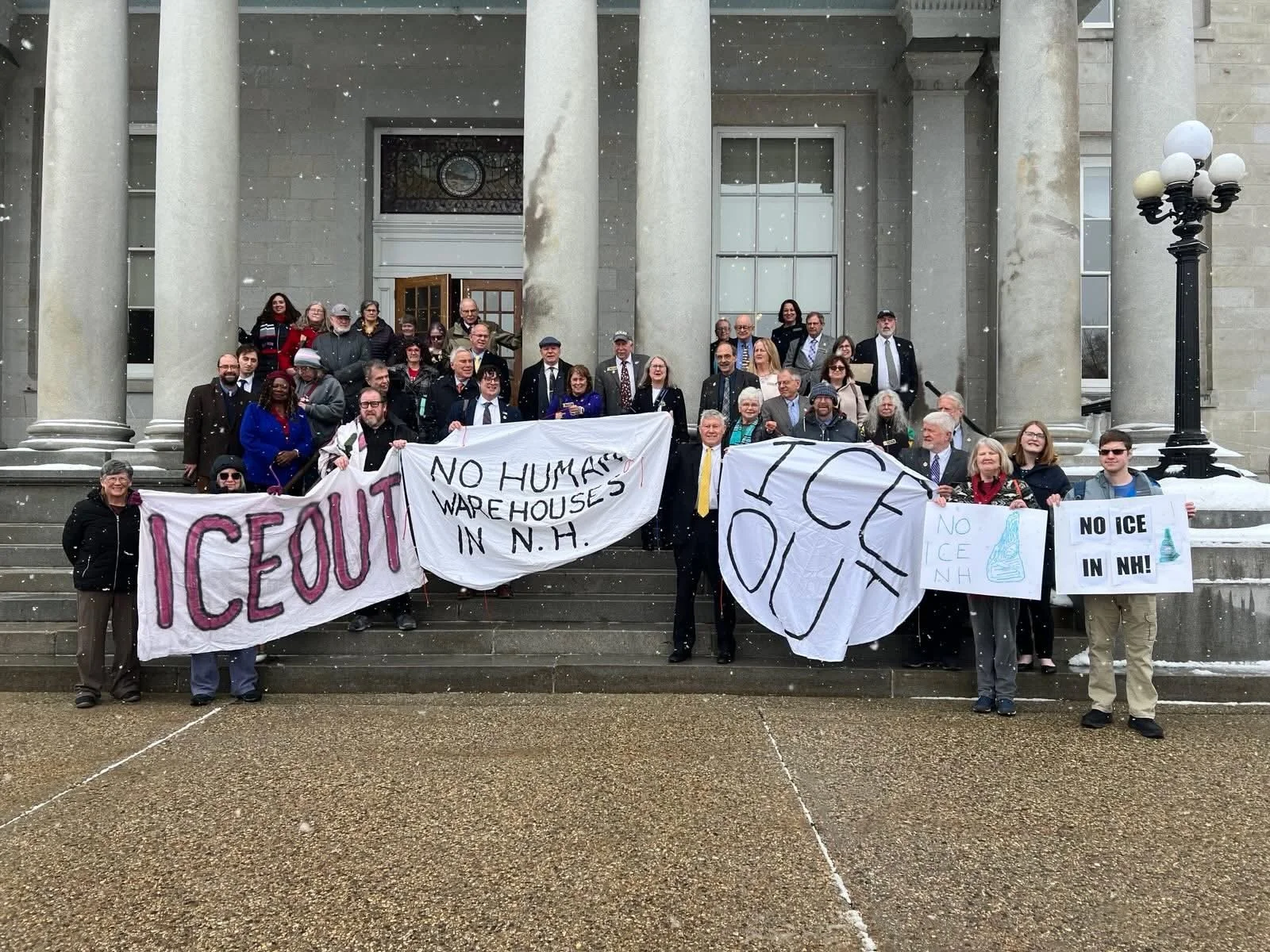
Immigration advocates and Democratic legislators showing solidarity with Merrimack residents opposing a potential ICE detention facility in their town.
There’s no getting around it. Wednesday and Thursday were two of the worst days for New Hampshire since Republicans took control of the legislature in 2021. But along with the lowlights, there were a few notable highlights. Here’s a quick recap of the good, the bad, and the ugly.
Setting the Scene
After navigating an ice storm to make it up to the State House on time, legislators were greeted by a cavalcade of cruelty, overreach, and grievance masking itself as public policy. While the weather delayed some reps and kept others away completely, Republicans held a large majority throughout a very long first day and a similar majority on Thursday.
The Good (It’s a short list-so don’t get too excited)
Control Over Local School Budgets Stays Local. HB-675 , a bill that would have established a Concord-imposed budget cap on local school districts was defeated by voice vote after an amendment surprisingly passed that took most of the teeth out a very bad bill. Falsely framed as “property tax relief” by Republican leadership, the bill would have made it impossible for school districts to address unexpected financial obligations that too often are the result of the state’s chronic failure to pay its share of the cost of funding public education. More.
Effort to Silence the Voices of NH Communities Fails. HB-314 would have severely restricted the ability of communities to spend funds to pay for the services of organizations—such as the New Hampshire Municipal Association—to lobby in their interest in the state legislature. It failed to win approval by a 152-198 vote margin and then was killed 203-147. Without being able to retain organizations such as NHMA, communities—including many smaller towns located far from Concord—would have been forced to expend limited resources to send a staff person or elected volunteer to travel to Concord in-person to testify on the dozens of bills impacting communities every legislative session. Worth noting is the real objective of this bill was to quash objections to Concord Republicans strangling the last vestiges of local control—and NOT to save taxpayers money as was claimed.
No Local Version of School Vouchers—for Now. HB-748, a bill that would have established a local version education freedom accounts to bust public school budgets, was tabled. This one is worth watching because it could come back as an amendment to a different bill later in the session.
The House Legalizes Cannabis—Again… (Yawn). HB-186 passed 208-135. While the bill would end arrests for simple cannabis possession and regulate sales like alcohol, like other legalization bills passed in the House over the past decade, it faces a murky future in the Senate—and a likely veto from the governor. As a reminder, back in August Gov. Ayotte said her position on legalization would remain unchanged even if the federal government moved forward with rescheduling the plant from a Schedule I substance to a Schedule III substance under the federal Controlled Substances Act (CSA). Other substance-related bills also passing included:
HB-54 , which would allow medical marijuana dispensaries (known as “alternative treatment centers,” or ATCs) to convert their dispensary licenses to become for-profit entities.
HB-751 , which would require private substance abuse disorder treatment programs, which now operate with no oversight and protections for clients, to be licensed by the state Department of Health and Human Services.
The Bad
Democratic Attempts at ACTUAL Property Tax Relief Shot Down. HB-651 , which would have the STATE pay its constitutionally-mandated share of public education costs—thereby providing significant property tax relief across the State—was killed 190-155 along partisan lines. The bill would have required the state to set state contribution levels to comply with the ConVal court order. New Hampshire's public schools rely heavily on local property taxes. NH's state contribution is the lowest in the nation and places a significant burden on local taxpayers. More. Meanwhile, HB-197 was killed 172-159. It would have provided $28 million in property tax relief by funding 7.5% of state retirement system contributions for Group I and Group II municipal employees. Until just over a decade ago, the state shared part of retirement funding costs for municipal employees with communities. But in 2011, Republicans zeroed out the state’s contribution—leaving cities and towns holding a very expensive bag whose cost was passed on to local property taxpayers. Since then, Republicans in the legislature have consistently fought efforts by Democrats to restore it, forcing communities to pick up the tab.
School Meal Bills Killed—Again. Two bills that would have seen the state pick up part of the cost for expanding access to free school meals were voted down. HB-665, killed 189-158, would have required the state to reimburse districts that provide free breakfast and lunch during school days for all students under 300% of the federal poverty level. SB-204 , killed 183-161, would have enabled school districts to expand school meals to students up to 200% of the poverty level and would have picked up part—but not all—of the cost.
Public Education Continues to Take a Beating. SB-33 , a book-banning bill similar to the one vetoed by Gov. Ayotte in 2025, passed 181-157. The bill sets up a process for anyone to challenge books or other materials in public schools as being inappropriate for a specific age level. HB-491, which would have established a committee to study alternative funding methods for public education and how to reduce reliance on local property taxes, failed by a 191-155 vote. More.
Hard-Labor Sentences Could Be Making a Comeback. SB-15 , originally a completely different bill until it was amended at the last minute in a process that provided no notice to key stakeholders, passed 179-159. The bill would reinstitute mandatory “hard labor” as a sentencing option for violent crimes, including capital murder and child rape. While no one has a surplus of sympathy for the people convicted of these terrible crimes, this bill starts our state down a path away from rehabilitation and towards retribution and vengeance. It would replace work efforts aimed at rehabilitation and education with work intended purely as punishment for a small group of inmates who would require additional security while working to protect other inmates from them—and in some cases, to protect them from other inmates. In a year when the legislature slashed tens of millions from the Department of Correction’s budget, the department could now be on the hook to come up with the funds to pay for a program it didn’t ask for at a time when other states are removing hard labor sentencing from their laws. More.
Bill Strips Municipalities and State Agencies of Remaining Power to Regulate Any Deadly Weapons. Not content with a law that already prohibits cities and towns from regulating firearms and knives in any way—including restricting them at public meetings and events—House Republicans passed HB-609 by a 193-151 vote. The bill expands the current prohibition to the regulation of tasers, pepper spray—or any “self-defense tool”—which could conceivably include blackjacks, brass knuckles, and other self-defense “tools” that Republicans have repeatedly attempted to legalize and normalize. The bill also casts the future of the Thunder Over New Hampshire air show at Pease in doubt. The show’s sponsor, the NH Air National Guard, is a state agency. Under the bill, state agencies are prohibited from regulating weapons in any way unless explicitly authorized. The Guard currently prohibits weapons from being carried by civilians past the point of entry. More.
Voting Rights Continue to Erode. Over the past five years, Republicans have led the charge to change New Hampshire from a state with extremely few documented cases of voter fraud where it was incredibly easy to vote—to a state that still has extremely few documented cases of voter fraud but where it is now much harder to vote. The work continued with the passage of a series of bills designed to throw more sand in the gears of a process that should invite participation rather than discourage it by establishing an endless series of hoops for qualified voters to jump though.
HB-323 passed 190-148. Framed as a voter-fraud measure, it would make a government-issued photo ID the ONLY means of acceptable identification in order to vote, raising new hurdles for many lawful voters—especially students, low-income voters, and people without a driver’s license. And speaking of fraud, during the debate, GOP Rep. Rep Ross Berry claimed there were 22 convictions for voter fraud in 2024 in New Hampshire. As one of my colleagues, Rep. Heather Raymond, pointed out later, that is a complete fiction. According to the Attorney General’s Office there were a total of 15 convictions for voter fraud in New Hampshire between January 2016 and September 2024–an 8 year timeframe. There were no convictions in November or December 2024. But there were over 100 voters turned away from the polls in the last 12 months because of changes to documents required for voting. Other anti-voter legislation also passed:
HB-317 , passed 187-150. It upends a long-standing New Hampshire law that allows a supervisor of the checklist to verify a voter’s identity if they personally know that person.
HB-158 , passed 179-157, further discourages absentee voting by allowing public inspection of absentee ballots. This would expose personal voting choices, erodes privacy, and potentially creates a safety risk by signaling that a home may occasionally be vacant, increasing the risk of theft
Housing Schmousing. HB-572, a pro-housing bill establishing and funding the “partners in housing” program to aid municipalities, counties, and developers in building workforce housing, was killed 191-156.
The Ugly
Anti-Abortion Bills Win Approval. If you were a voter who fell for the pinky promise of NH Republicans not to pass any new abortion bills if you voted them back into office, bad news. You were played. HB-232 , billed as establishing a “right of conscience for medical professionals”—but in reality a bill that will allow anyone working in a healthcare facility to turn away a patient seeking abortion care without explanation or referral—passed 184-164. The bill also prohibits employers from making business decisions to change schedules and duties for employees who refuse to serve these patients. Meanwhile, over in the Senate, HB-191 passed 16-8 along party lines. It would make it illegal to help a minor travel to receive an abortion — or any other procedure — without parental permission. Worth noting is that state law already requires parental consent for a child to receive an abortion. Sen. Tara Reardon argued the bill which was expanded to all surgical procedures—could criminalize transporting children to doctor’s appointments as routine as the removal of wisdom teeth. More.
Previously-Flushed Anti-Trans Bathroom Bill Is Back. SB-268 , another priority of New Hampshire’s GOP culture warriors, moves on to the governor for signature or veto by a 185-159 vote. It represents yet another attempt to create unsafe and exclusionary conditions for transgender individuals from bathrooms and sports teams based on “biological sex.” Similar bills have been vetoed by both recent Republican governors because they undermine nondiscrimination protections.
New Roadblocks to Healthcare and Public Assistance for People in Poverty. SB-134 passed 204-150. It aligns New Hampshire Medicaid work requirements with onerous new work requirements passed by Congress as part of Trump’s Big Beautiful Bill. In addition to forcing people out of the program who can’t work due to childcare or family obligations, new requirements shift away from simple self-reporting to stricter verification of employment via payroll/enrollment data requiring formal documentation. This change alone will impact millions who now risk disenrollment if this requirement isn’t met. Meanwhile, HB-348 , a mean-spirited bill that limits public assistance to those in need and allows communities to “opt out” of providing aid, passed 190-157. To receive aid under the bill, people would now be required to provide documents that many needing aid simply don’t have—like property tax bills, car leases, and so on. Current law requires communities to provide assistance to the needy regardless of residence—an obligation that has been a hallmark of New Hampshire law since colonial times.
What’s Next?
Senate bills approved in the House that were not amended can go to the governor for signature. However, the Senate bills that were amended must go back to the Senate for a concurrence vote before they can go to the governor. Meanwhile, most House bills approved last week will go over to the Senate for a new round of public hearings and votes. But some—especially the ones with large price tags—may be referred to the House Finance Committee or another second committee for additional work.
Public hearings on 2026 bills start next week at Granite Place—the temporary home of House committees while work continues on the renovation of the Legislative Office Building. You can see the full hearing schedule on the House Calendar.